_1793675472585.png)
AI has moved from answering questions to closing transactions
For two years, AI search was discussed far more than AI commerce. Since the third quarter, that has changed in China and abroad at the same time.
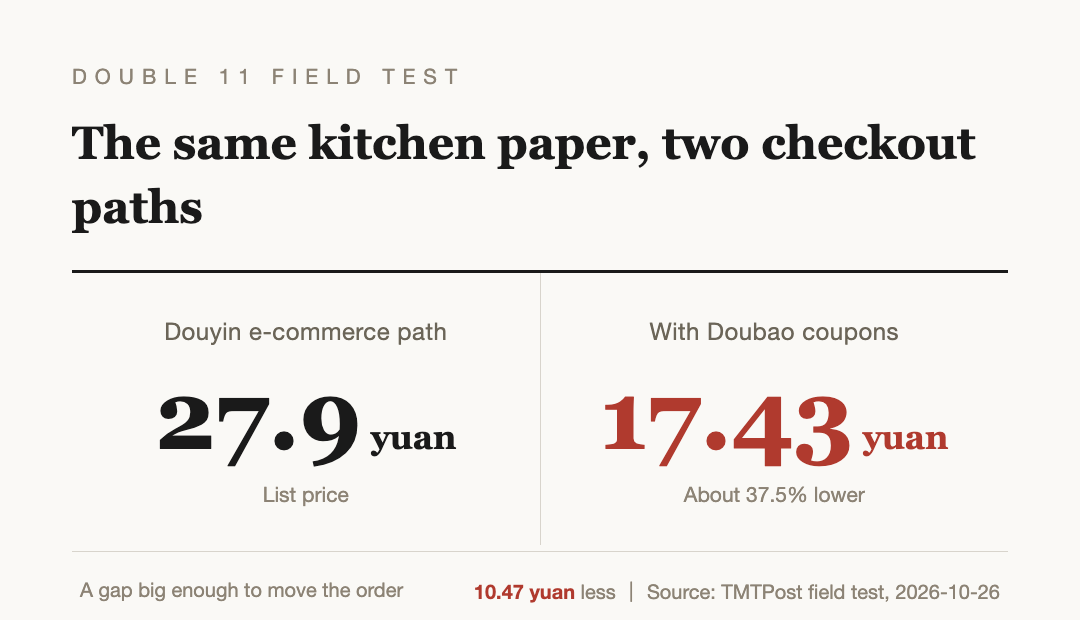
In China, AI entry points have started to carry transactions. Doubao introduced the "Ask Doubao before buying" entry during Double 11 and distributed coupons through Doubao, Toutiao and other products. In one media test, the same roll of kitchen paper cost 27.9 yuan on the Douyin e-commerce path and 17.43 yuan with coupons via Doubao — a gap big enough to move an order to a different checkout (TMTPost, 2026-10-26).
Qwen's "Double 11, help me choose" now covers selection, ordering and even payment inside the app; Qwen Office's e-commerce edition reports that about 20% of its paying users come from the e-commerce industry (21st Century Business Herald, 2026-10). Earlier, in October 2025, Doubao rolled out a "recommendation to marketplace" function that takes a user from question to order in about ten seconds.
Overseas, shopping agents are becoming infrastructure. Shopify launched Agentic Storefronts and WebMCP support, letting external AI agents read product information and assist with orders within compliance boundaries. Walmart opened an Agent Gateway MCP server for agents to shop on its site. Meta's Muse goes further — a personal agent that compares and orders across apps; Amazon, citing its automated-shopping restrictions, blocked Muse's access to its store (TechCrunch and other public reports, 2026-10).
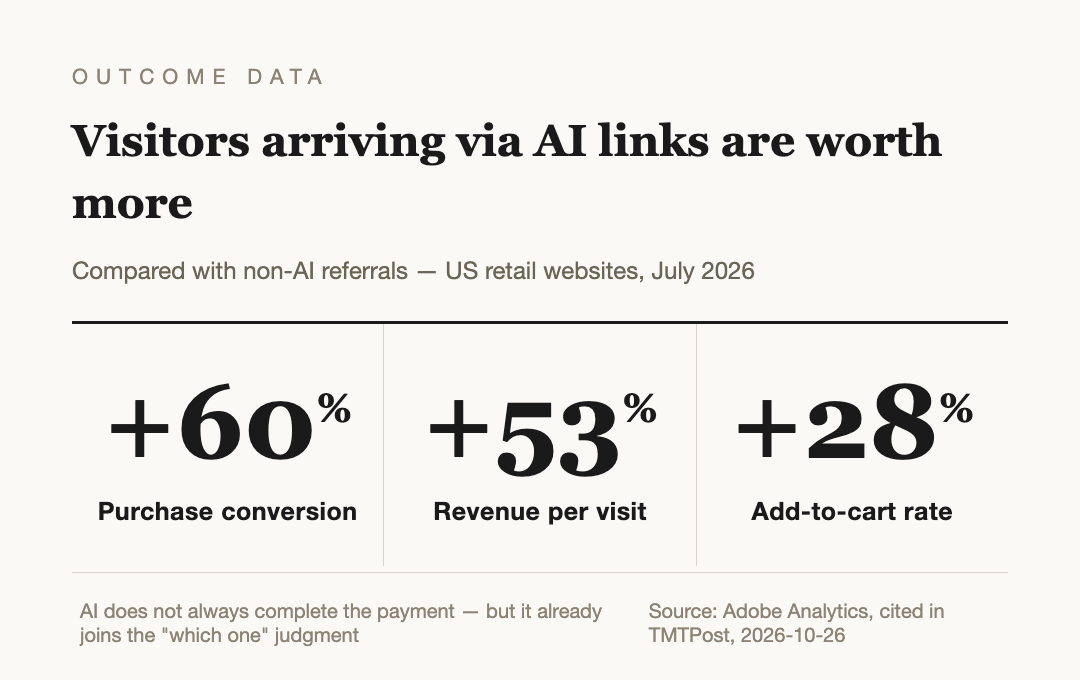
Evidence on the outcome side has appeared as well. Adobe's monitoring of US retail websites shows that in July 2026, visitors arriving via AI links converted 60% better than non-AI referrals, generated 53% more revenue per visit and added to cart 28% more often (Adobe Analytics, cited in TMTPost, 2026-10-26).

Why this shift is structural for brands
Entry-point migration happens every year. This one differs in kind.
The decision entry point has moved upstream. Brand visibility used to compete at two locations: the search results page and the e-commerce shelf. Now there is a position in front of both — the AI answer. When a user asks AI what to buy in a category and which brand to pick, the few lines AI returns replace much of the earlier searching, review-reading and comparing. Brand information the AI does not adopt is absent from that round of decision-making.
The second page is gone. However poor conventional search gets, users can still scroll. A generative answer cites a limited set of sources, and most users read only the first round. Whether AI adopts your brand matters more than search rank, because the shortlist has only a few slots.
Trust is the precondition. When AI generates a recommendation, it works from how well it understands the brand and how confident it is: whether information is consistent across the web, whether authoritative corroboration exists, whether key claims can be verified. Advertising buys exposure; it does not buy the AI's trust. The search-era logic of "position goes to the highest bidder" does not work here. GEO (Generative Engine Optimization) addresses the former: making a brand an authoritative source that AI is willing to cite when generating answers.
Three common misjudgments
Treating it as an advertising problem. Some read "being mentioned by AI" as "buying ads on AI platforms". Platforms are still exploring ad formats, and ads buy exposure, not the AI's understanding of and trust in a brand within organic answers. Where brand information lacks consistency and authoritative corroboration, the brief mention an ad buys rarely settles into a lasting preference in answers.
Assuming a good website is enough. AI collects brand information from far beyond the official site: media coverage, third-party reviews, Q&A communities, industry directories and government filings all feed its judgment. The website provides only part of the facts; AI forms high confidence only when independent sources corroborate one another. Running the website while ignoring web-wide consistency is the most common gap today.
Waiting for platforms to set the rules. The infrastructure of agentic shopping — catalog interfaces, order-on-behalf protocols, agent access rules — is still evolving, and some companies are watching and waiting. Transaction rules keep changing, but the mechanism by which information is understood, trusted and cited by AI has been running since generative engines launched, and it waits for no one. Transaction interfaces can wait; content assets cannot, because late starters face an answer landscape that has already set.
Four things you can do now
- Make it readable for AI. Deploy structured data across the official site and core content pages: Schema semantic markup, a clean site structure, well-formed product and service descriptions. Content that AI struggles to crawl or parse never enters the candidate pool, however good it is.
- Make it citable by AI. Organize content around how users actually ask, and rebuild product material into well-structured "answer-type" content: answer the question directly, give the basis, state the conditions and limits. AI prefers to cite information that directly supports its answers; promotional copy does not.
- Make it trustworthy to AI. Build authoritative signals systematically: verifiable corporate credentials, industry standards you helped draft, filings from governments and third parties, and a consistent public data line. These carry heavy weight in AI's confidence assessment and are hard to copy in the short term.
- Make results attributable. Set up citation monitoring across major AI platforms, tracking brand performance on real devices, networks and query contexts rather than one-off simulated assessments. What is measured can iterate; what is attributable can be budgeted.
FAQ
Do consumers really make purchase decisions with AI?
They do. Adobe's monitoring shows AI-referred visitors convert better, and posts asking large models what to buy were common on social platforms during this Double 11. More precisely: AI does not necessarily complete the payment, but it has very likely joined the "which one" judgment.
Order migration has its own sequence, but information being collected and understood by AI happens every day. Wait until orders visibly shift, and what you must build is the content asset others have spent years accumulating. Two low-cost steps to start with: audit the site's structured data, and turn common purchasing questions into answer-type content.
No. The basics of being readable and trustworthy to AI overlap heavily with the technical health and content quality of SEO. Companies with an SEO foundation are mostly adding an AI perspective to their existing content system.
Closing
In the last round of search competition, companies fought over keyword rankings. In this round, they need to build a brand entity that AI can understand, trust and cite. Beyond the website and social media, credibility and citation rate inside AI answers are becoming new infrastructure of brand digital assets. This year's Double 11 simply made it visible.
One thing you can do right now: on the AI platforms you use, ask a purchasing question about your industry — "how do I choose XX" or "who are reliable suppliers in XX" — and watch how AI describes your company, and whether it describes it at all. If the answer falls short of expectations, that gap is where the investment should start.
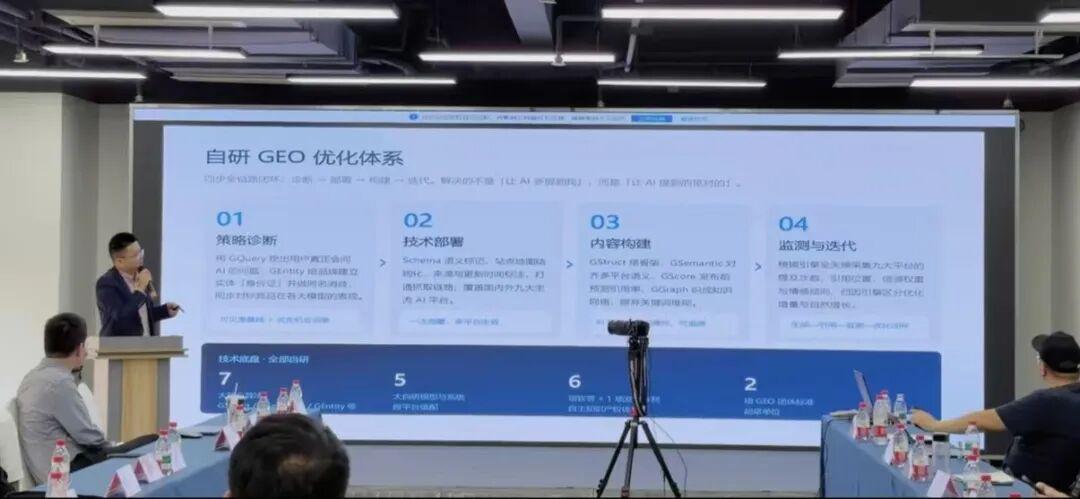
New Galaxy AI specializes in Generative Engine Optimization (GEO), headquartered in Xiaoshan, Hangzhou. Its services cover strategy diagnosis, technical deployment, content construction, and monitoring and iteration. If the check reveals a visibility gap, start with an AI visibility diagnosis.