Give a generic answer first, follow up with multiple-choice questions to fill in the requirements, and only then deliver a tailored plan. Doubao, ChatGPT and other mainstream AI assistants are converging on this clarify-then-answer pattern. For brands, the competition to be recommended now starts at the options page, not the answer page.
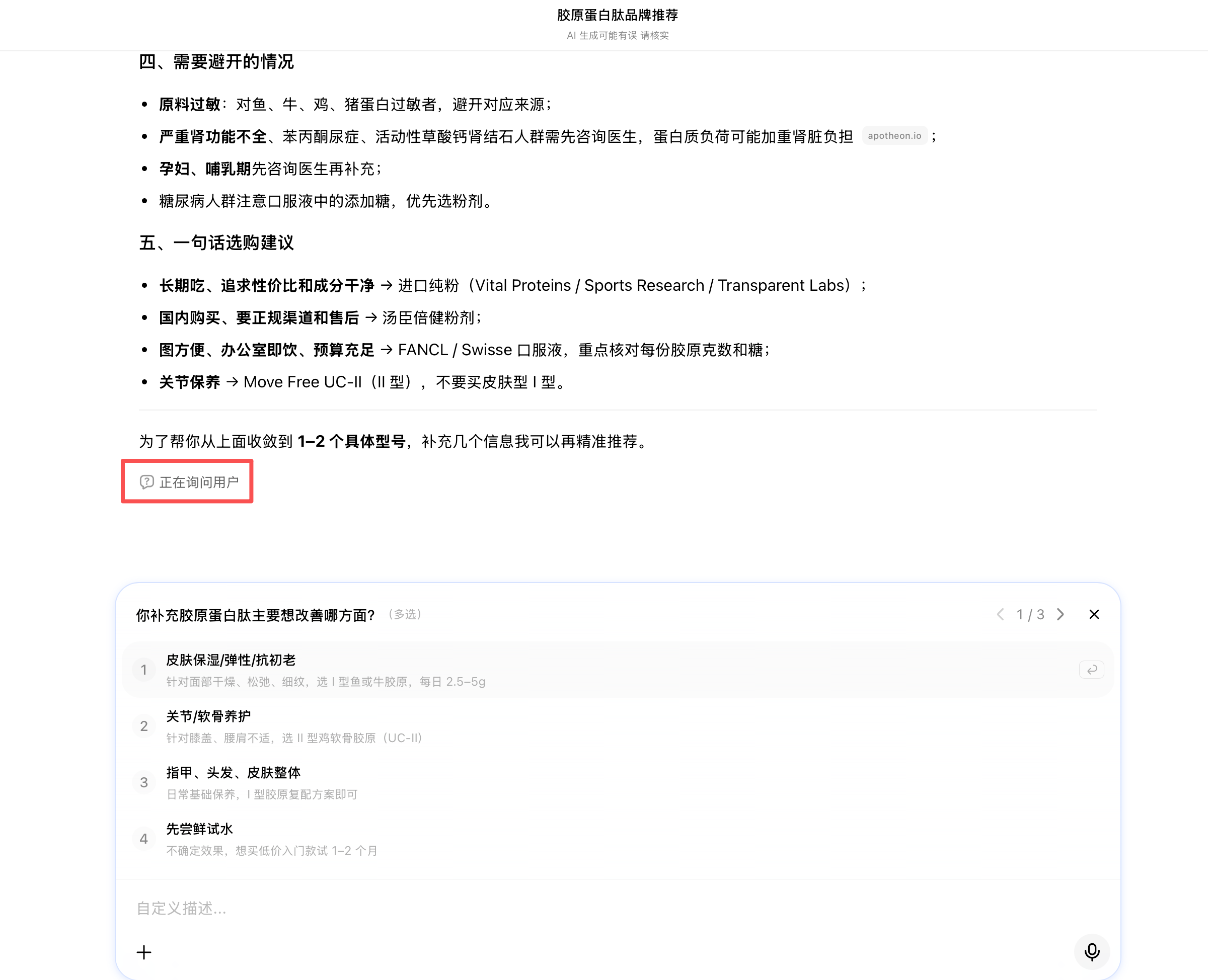
Ask Doubao "how do I choose a collagen peptide supplement" and a new pattern appears: the assistant first returns a recommendation covering the general case, then the interface shows an "asking the user" state with a form-style questionnaire — Which aspect do you want to improve? Skin hydration, joint support, hair and nails, or trying it first — each option carrying a one-line note underneath. Only after three answers does it deliver a recommendation narrowed to specific types and dosages.
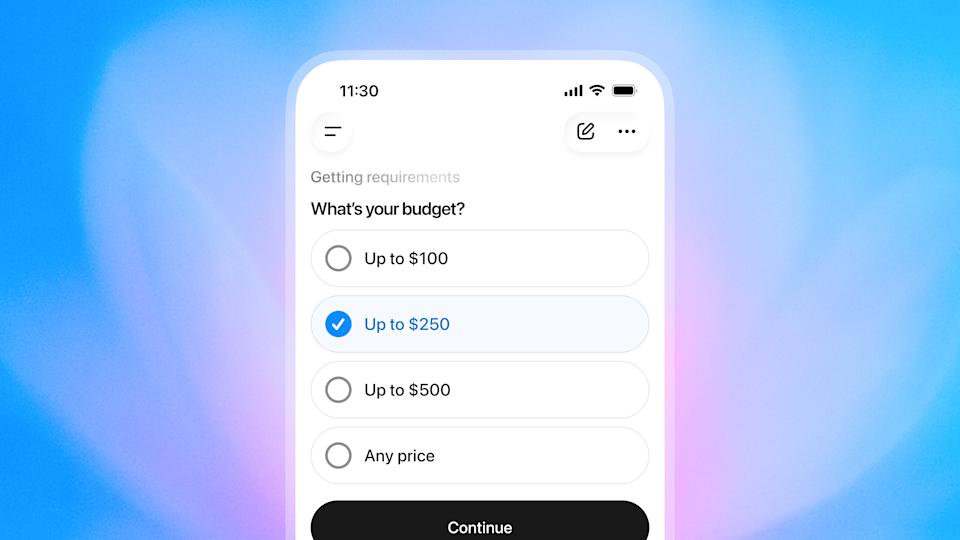
Where the Multiple-Choice Questions Come From: How Clarifying Questions Are Generated
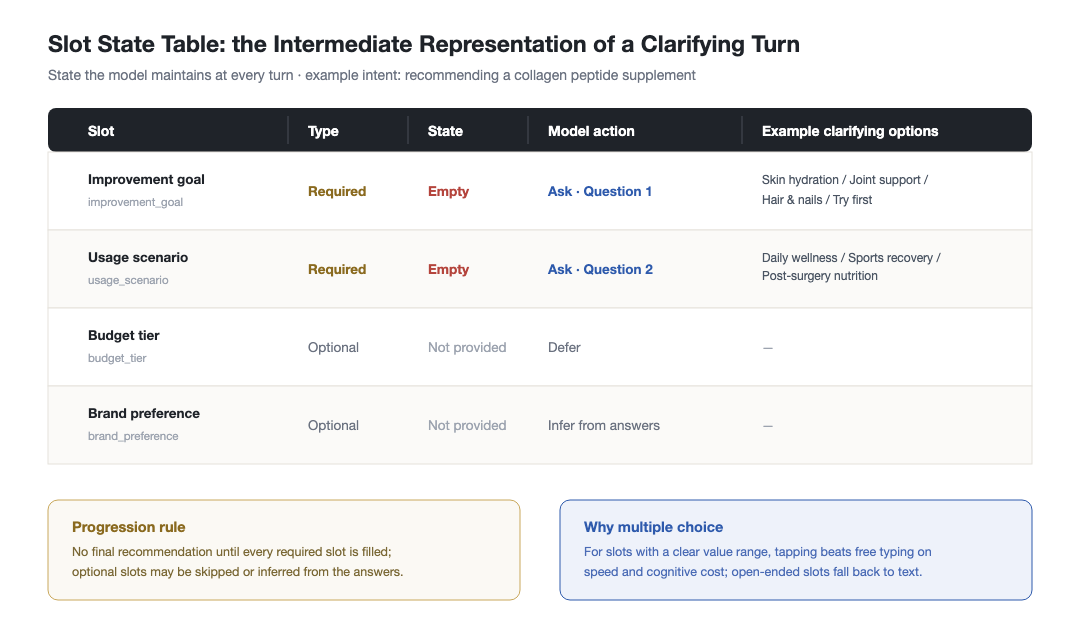
The options look hand-configured, but most of them are generated dynamically by the model during the conversation. The mechanism has three layers.
The first layer is intent recognition and slot definition, the source of every follow-up. After receiving a request, the AI determines the task type and breaks the parameters needed to complete it into "slots": a flight booking needs origin, date and cabin class; a collagen recommendation needs improvement goal, usage scenario and budget. Information already provided fills the corresponding slots automatically, and the empty slots become the follow-up list. Doubao's disclosed generation pipeline shows that at the understanding stage the system performs scene classification, latent-need mining and constraint extraction simultaneously, and in multi-turn conversations it resolves references from earlier context, so information already given is never asked twice.
The second layer is option generation. For dimensions with a well-defined value range, the model clusters high-frequency values into candidate options: "skin", "joints" and "hair and nails" in the collagen scenario are essentially common clusters of user intent for the category, while budget tiers correspond to common spending ranges. The one-line notes under each option in the screenshots ("choose Type II chicken sternum collagen, UC-II"; "choose Type I marine or bovine collagen, 2.5–5 g daily") are likewise induced by the model from content corpora, compressing the technical meaning of each value into a single line.
The third layer is the trigger condition. Clarification is not the default behavior: the model judges whether the missing information would materially change the answer. Asking for "three synonyms of important" is not worth a follow-up; asking for "a collagen recommendation" is, because different goals lead to completely different answers. Tool-like scenarios (booking, form filling) also carry predefined slot templates that make follow-ups more fixed, while open consultation scenarios generate follow-ups entirely from context.
The Inside of a Clarifying Turn
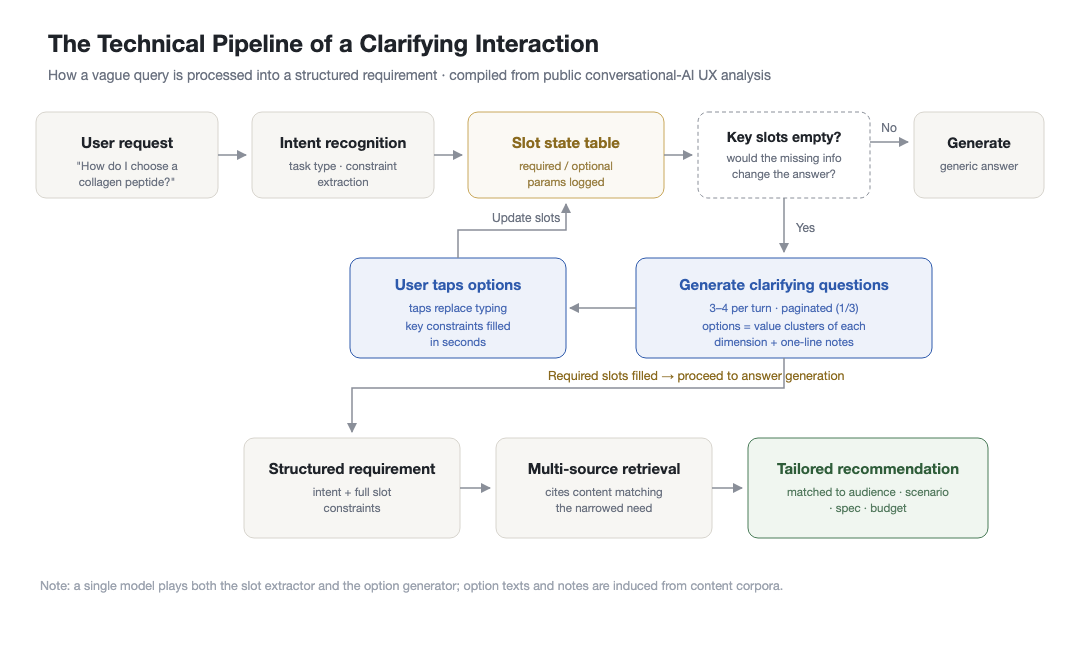
The slot state table can be expressed directly as JSON — the intermediate data the model actually maintains at every turn:
{
  "intent": "recommend_collagen_peptide",
  "slots": {
    "improvement_goal": { "required": true,  "value": null, "action": "ask"   },
    "usage_scenario":   { "required": true,  "value": null, "action": "ask"   },
    "budget_tier":      { "required": false, "value": null, "action": "defer" },
    "brand_preference": { "required": false, "value": null, "action": "infer" }
  },
  "clarify_policy": {
    "ask_when": "missing_and_matters",
    "max_questions_per_turn": 4
  }
}
Modern implementations have no rule engine running beside the model: slot extraction and option generation are performed by the same model, with the system prompt constraining the output format and the model returning its state through structured protocols such as JSON Schema. Two details in the screenshots follow from this: option wording varies slightly between sessions because it is generated on the fly, while the order of dimensions stays stable because it is determined by the parameter structure of the task itself. Pagination (1/3, 2/3) is an engineering choice as well — the number of questions per turn directly affects drop-off, and three to four questions is the balance between informational completeness and completion rate.
Why Ask Before Answering: The Product Logic Behind the Pattern
The design addresses a single contradiction: the requirement a user expresses is always incomplete, while the answer an AI delivers must be complete.
For users, the value comes in three forms. Intent precision: from "the AI guesses what I want" to "the AI confirms what I want," cutting the cost of wrong guesses. Lower communication cost: multiple choice turns "describing a requirement in words" into "tapping," with three or four questions per screen and a dozen seconds replacing a two-to-three-hundred-character explanation. Better output quality: once the constraints are gathered, the AI no longer produces generic category overviews but recommendations matched to audience, scenario and budget — a pattern described in conversation-UX analysis as "ship partial value first, then fill in the details." While clarification is under way, the user already holds a usable generic answer.
For platforms, the structural meaning is larger. The clarification step moves requirement definition inside the conversation: search engines once relied on users to come up with keywords; now the AI actively processes vague intent into structured requirements. Whoever owns the structure of the requirement decides what gets retrieved, cited and recommended downstream. The AI is moving from an answer engine to a requirement processor — another upgrade in the value of the Q&A entry point.
How Brands Get Selected in the Clarifying Step: The New Proposition for GEO
For the GEO industry, clarifying interactions change where visibility is produced. GEO used to care about whether the answer contains the brand; now it must also ask whose material the AI used to build the options. Three directions follow.
Organize content by intent dimensions, because your content is the raw material from which the AI builds its options. The dimension–value–note triple behind each clarifying option has to be extracted from content corpora: which dimension is worth asking, how each value should be named, what each value technically means. The "answer atom" concept in New Galaxy AI's whitepaper matches this requirement exactly — break long content into the smallest semantic units that can independently answer a specific sub-question, each carrying a clear audience, scenario and specification. When the AI needs a one-line note for the "joint support" option, whoever provides clean, accurate, directly extractable atoms gets into the options.
Writing with explicit conditions matters just as much: state who a product suits and who it does not. The Doubao screenshot includes a dedicated section on "what to avoid" — people allergic to specific sources, groups who should consult a physician first, people with diabetes preferring powder formats. Exclusionary information is exactly the hard constraint an AI needs for precise recommendations. Content that states its applicable conditions and contraindications explicitly has a visibly higher chance of being hit by the narrowed retrieval after clarification; a vague "suitable for everyone" leaves nothing to extract. The whitepaper's data supports the same point: structured FAQ modules noticeably increase extraction probability, and citing statistics with sources can raise AI citation rates by 37–40%.
The third direction is dual positioning across broad and niche intents. The generic-answer-then-clarify flow means one query produces two citation decisions: the first, generic answer draws on category-level content, while the tailored recommendation after clarification retrieves niche-scenario content. Covering only broad keywords like "which collagen peptide brand is good" is no longer enough; narrowed long-tail queries such as "Type II collagen joint supplement" or "marine collagen content sensitive skin" are the real battlefield of the second citation. New Galaxy AI's GQuery algorithm — mining users' real questions into a topic pool — does precisely this: grounding content planning in the actual distribution of intent.
The three entry points and their content requirements can be combined into one diagram:
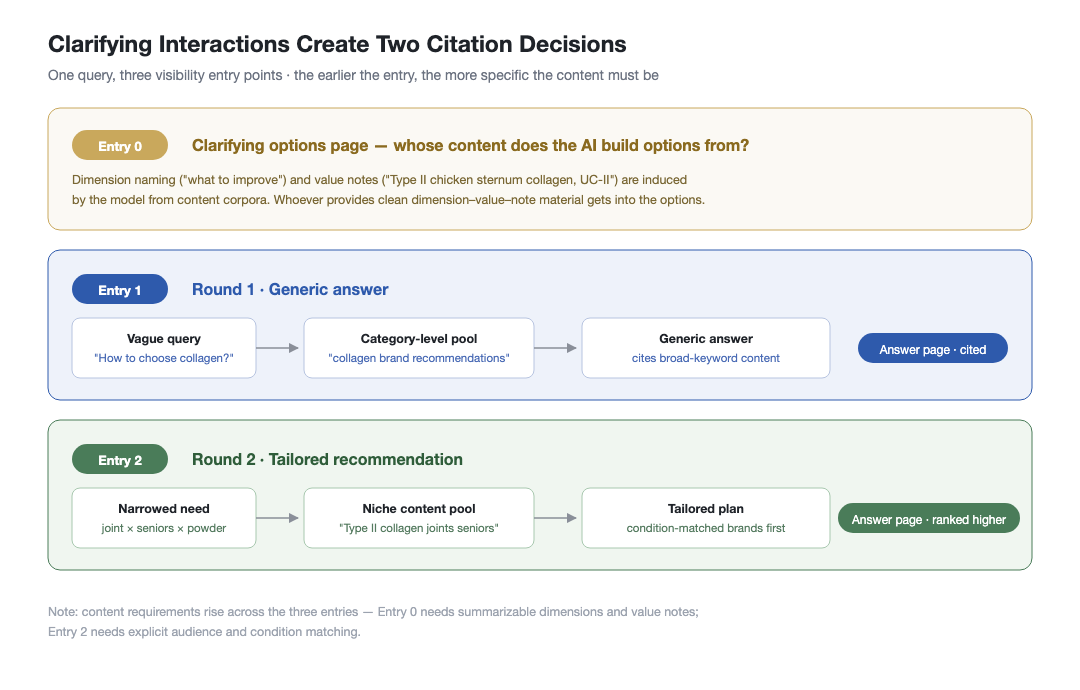
Dimension | Direct-answer mode | Clarifying-interaction mode |
|---|---|---|
Citation decisions | One (after the query) | Two (generic answer + post-clarification recommendation) |
Retrieval scope | Category-level broad keywords | Narrowed to audience / scenario / specification |
Visibility entries | Cited on the answer page | Hit on the options page + cited on the answer page |
Content requirements | Authoritative, structured | Authoritative, structured, and atomized by intent dimension |
Action Checklist
- Map the user-intent dimensions of your core categories — improvement goal, audience, usage scenario, budget tier — into a content matrix, with one piece of content or one content unit per intersection
- State the applicable conditions and exclusions for every piece of content, giving the AI the hard constraints it needs for precise recommendations
- Rewrite product specifications, audiences and usage advice into independently extractable answer atoms — one idea per paragraph, with data and its measurement basis attached
- Monitor brand performance under clarifying scenarios: test with both vague queries and requirement-completed precise queries, and log the brand's appearance in both rounds of answers
FAQ
Will clarifying follow-ups replace direct answers?
No. The model clarifies only when missing information would materially change the answer; simple factual questions still get direct answers. But for high-value decision scenarios — shopping, product selection, planning — clarification is becoming the default flow.
Are the options manually configured by the platforms?
In open consultation scenarios the options are generated dynamically by the model from intent clusters; tool-like scenarios carry predefined slot templates. In both cases, the wording material of the options comes from the content corpora the model has learned from.
Is this good or bad for smaller brands?
It depends on content readiness. Clarification narrows the retrieval scope, reducing the weight of broad-keyword competition and raising the weight of niche-scenario matching. For smaller brands with well-prepared content on specific dimensions, the chance of being precisely recommended actually increases.
Closing
Clarifying interactions turn "incomplete requirements" from the user's problem into the platform's process, and split the competition for visibility into two stages: being hit on the options page, and being cited on the answer page. The first determines how the AI understands the question space of a category; the second determines whom the AI recommends inside a narrowed requirement. Organizing content by intent dimensions, writing with explicit conditions, and atomizing expressions are no longer bonus points under clarifying interactions — they are the ticket into the recommendation pipeline.
Doubao collagen recommendation and ChatGPT budget follow-up: interface screenshots taken in November 2026
Slot filling and clarifying follow-ups: AI 总猜错意图?教你一招让 AI 有效追问,精准执行 (UISDC)
ChatGPT clarify-then-act patterns: ChatGPT Human-in-the-Loop UX: Clarify & Handoff Patterns (AI UX Playground)
Doubao's answer-generation pipeline (intent recognition, constraint extraction, context completion): 豆包 AI 是如何「思考」的?拆解豆包的回答生成全链路 (GTHBox)
"Answer atoms," GQuery, structured FAQ extraction gains, and the 37–40% citation-rate figure: New Galaxy AI GEO Optimization Whitepaper v2.0 (July 2026); the citation-rate figure follows the statistical source cited in the whitepaper
The slot state table JSON and pipeline diagrams in this article are illustrative structures describing mechanisms from public sources, not the internal implementation code of any platform